System 1 and System 2 Thinking
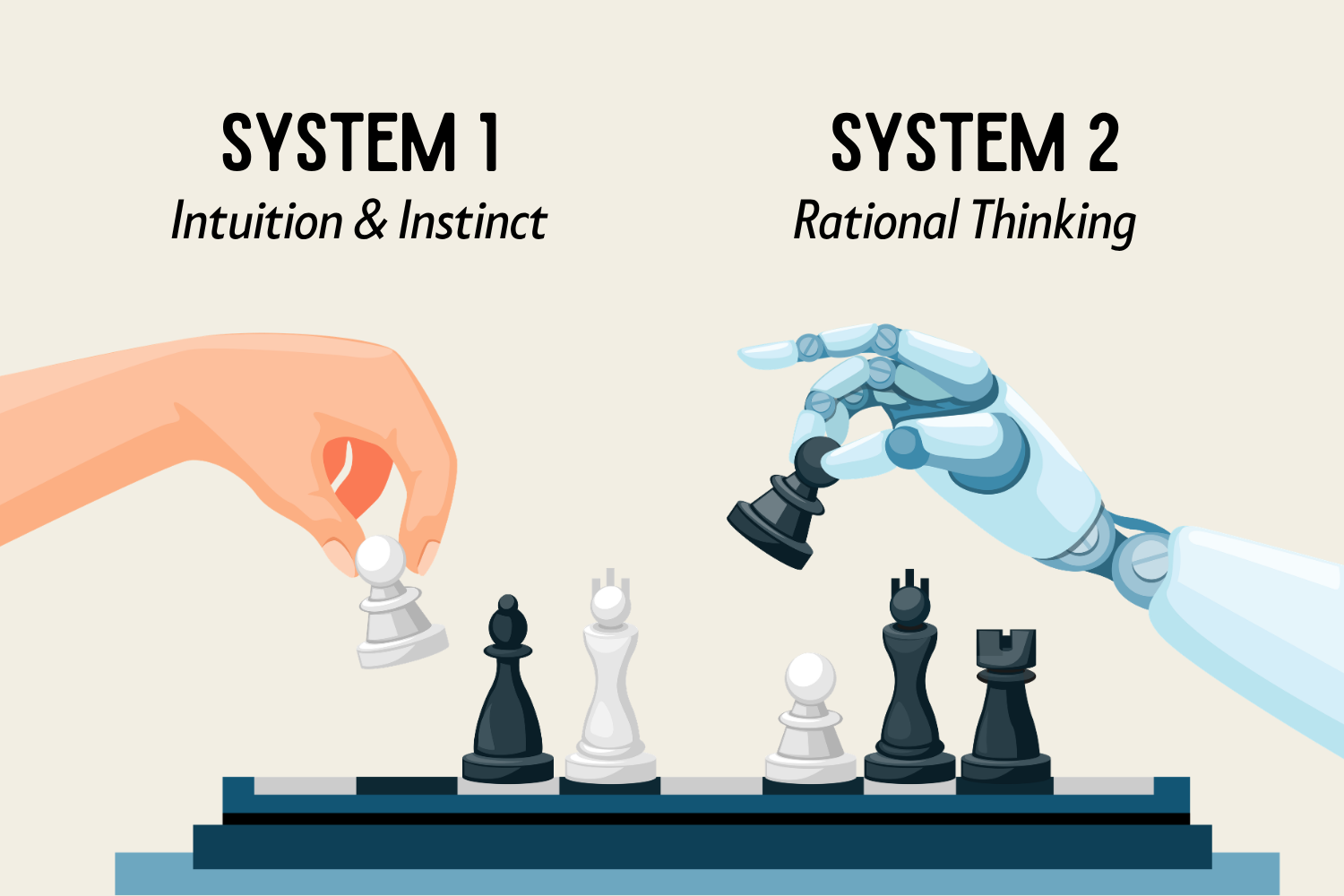
Your brain runs fast, gut-level System 1 and slow, deliberate System 2 — knowing which a moment needs is the skill.
 Find this on the mind-map
Introduction
Psychologist and Nobel laureate Daniel Kahneman laid this out in his 2011 book Thinking, Fast and Slow, the product of decades of research alongside his collaborator Amos Tversky. Their claim was simple and a little unsettling: you don't have one way of thinking, you have two, and you're switching between them constantly without noticing.
How It Works
Both modes are always on. Neither one is "the good one." The skill is knowing which one a given moment deserves.
| System 1 (Fast) | System 2 (Slow) | |
|---|---|---|
| How it runs | Automatic, effortless | Requires focus and mental effort |
| What it uses | Intuition, emotion, pattern recognition | Logic, analysis, structured problem solving |
| What it produces | Snap judgments, gut reactions | Considered conclusions, complex decisions |
| Weakness | Prone to bias and error | Slow and mentally expensive |
| Analogy | The survival instinct | The rational thinker |
Where System 1 earns its keep. Three situations reward fast thinking. Crisis management — a security breach or an outage doesn't leave room for a deep-dive; you need damage control in the first few minutes. Reading people — body language, tone, energy in the room will tell you there's a morale problem long before a survey ever would. Rapid business calls — a competitor's surprise launch demands a pivot built on market instinct, not three months of research.
Where System 2 earns its keep. Three situations reward slow thinking instead. Strategic planning — entering a new market needs demand data, a competitive read, financial viability, regulatory exposure. Genuinely hard problems — a client contract on the edge of walking needs real root-cause work, not a reflexive discount. Performance reviews and promotions — the most visible result in the room can easily hide who actually earned it.
The two aren't a choice you make once — they're meant to run in sequence. Use System 1 to handle the immediate response, then bring in System 2 for the real evaluation once the dust settles.
Why It Matters for Leaders
Most of your calls as a leader get made by System 1, and most of the time that's completely fine — years of pattern recognition have built intuitions that are fast and usually good enough. Where System 1 breaks down is a narrow band: situations you haven't seen before, high emotional stakes, and anywhere a bias is quietly making the call for you.
That narrow band is where the expensive mistakes live. System 1 is the engine behind nearly every cognitive trap you've heard of — confirmation bias, anchoring, the availability heuristic, overconfidence, sunk cost, the halo effect, recency bias. All of them run automatically, and all of them feel like judgment while they're running.
Here's what that costs in practice. A sales leader watches Mark close a big deal and instinctively wants to promote him. Look at the actual project data from the months before, though, and it was Susan who built the pitch and made the case that won the client — she just did it less visibly. System 1 rewarded the person who closed in the room. System 2 is what finds the person who actually did the work.
It runs the other way too. Lean on System 2 too hard and you'll burn committee time and analysis on calls that are cheap and easy to reverse, slowing your whole organization down to guard against a risk that was never really there.
What this framework actually changes for you isn't that you start thinking harder. It's that you get a switch. You can name which mode you're in right now, notice the moment a situation has outgrown it, and deliberately shift gears.
What to do next
Test your knowledge of System 1 and System 2 Thinking
Practice System 1 and System 2 Thinking
Apply System 1 and System 2 Thinking to a real situation
Skills related to System 1 and System 2 Thinking

Frameworks related to System 1 and System 2 Thinking

Abilene Paradox
A team can agree to something nobody wants — not from pressure, but because everyone assumes they're the only doubter.

Cynefin Framework
Dave Snowden's model sorts problems into four domains — Clear, Complicated, Complex, Chaotic — by cause-effect clarity, then matches your response.
Occam's Razor
Among competing explanations, pick the one with fewest assumptions — in leadership, diagnose simply, build lean, and say what actually matters.

OODA Loop
John Boyd's four-stage decision cycle — Observe, Orient, Decide, Act — for fast, adaptive calls under pressure, run as a loop.

Probabilistic Thinking
Stop betting on one predicted future — assign real probabilities to outcomes, weigh them by impact, and let the math decide.
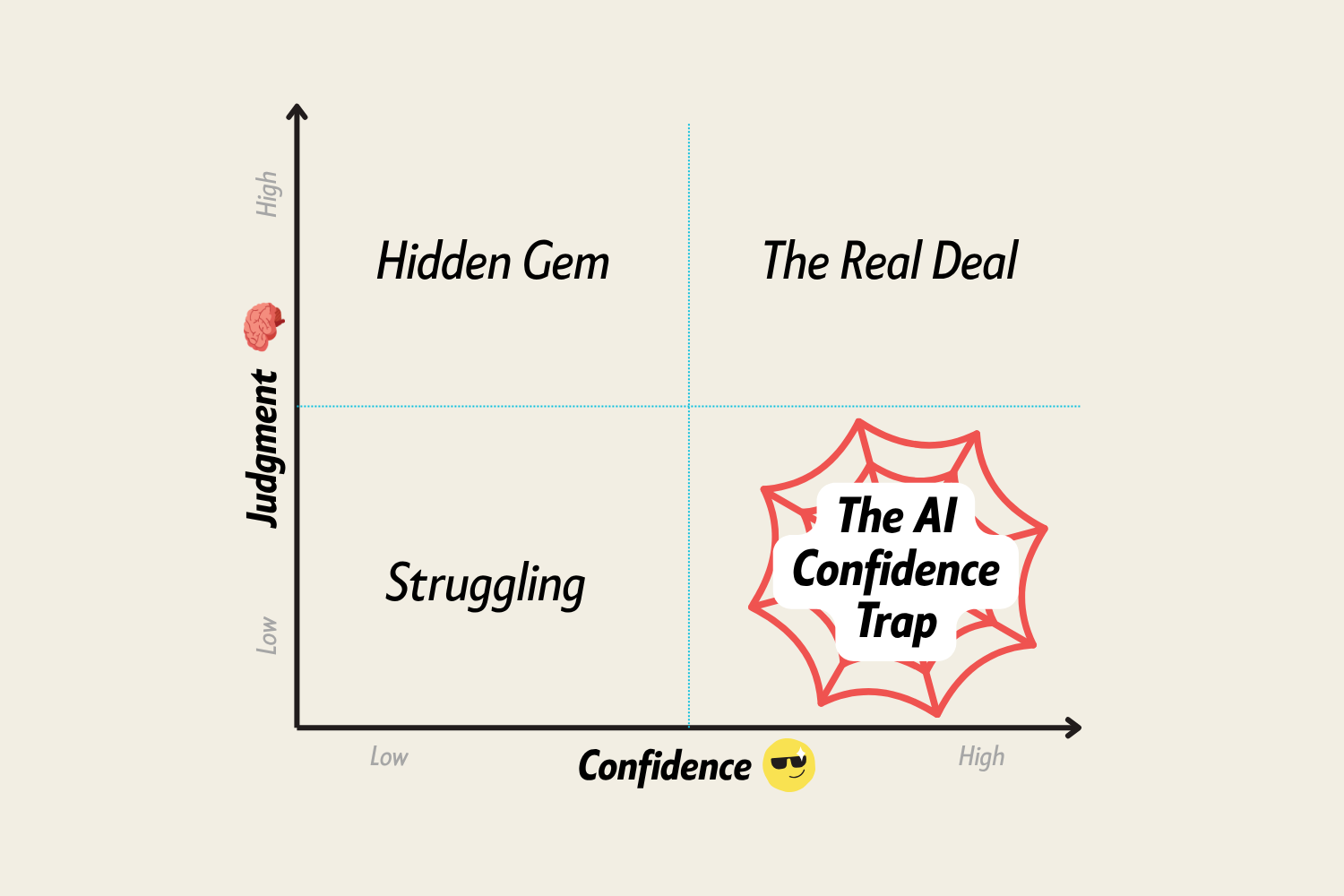
The AI Confidence Trap
AI-polished output can look like real competence when the thinking behind it isn't there — judge the reasoning, not the polish.
Books that reference this framework
Books related to System 1 and System 2 Thinking

Blink
Malcolm Gladwell's dive into the two-second judgment: when snap decisions beat deliberate analysis, when they betray you without warning, and why you usually can't tell which is happening in the moment.

Clear Thinking
Shane Parrish's case that your biggest decisions aren't won by thinking harder in the moment. They're won or lost by the defaults you've already built long before the moment arrives.

Principles
Ray Dalio's attempt to turn decades of painful mistakes at Bridgewater into explicit, written rules, a bet that most bad decisions come from never writing down what you actually believe until you're forced to.

Same as Ever
Morgan Housel's case for studying what never changes about human behavior, risk, and decision-making, instead of exhausting yourself trying to predict what will, because the next crisis will look nothing like the last one, but it will be caused by the same handful of things that have always caused them.

Thinking, Fast and Slow
Daniel Kahneman's decades of research into the two systems running your mind, and why the fast, confident one is usually the one making your worst decisions, not your best ones.

Thinking in Bets
Former professional poker player Annie Duke's case that every decision is a bet made with incomplete information, and that judging decisions by their outcomes, the way almost everyone does, teaches exactly the wrong lessons.